Prime Minister Mark Carney and President of the European Parliament Roberta Metsola participate in a joint news conference at the European Parliament in…
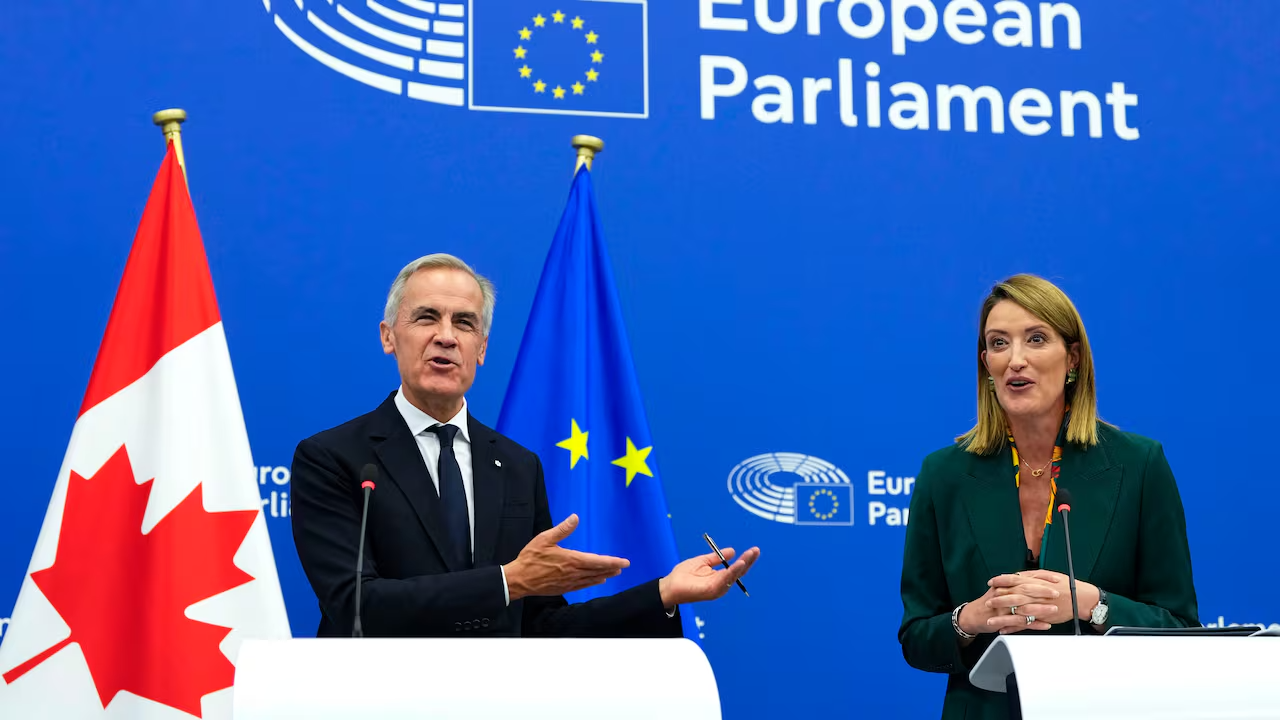
Prime Minister Mark Carney and President of the European Parliament Roberta Metsola participate in a joint news conference at the European Parliament in Strasbourg, France, on Thursday, Sept. 17, 2026. (Justin Tang/The Canadian Press)
Canadian Prime Minister Mark Carney told the European Parliament on Thursday that Canada "welcomes the ambition" of a European proposal to make it the EU's first-ever "associate member," a day after U.S. President Donald Trump warned he would consider the move a possible "hostile act" against the United States.
The proposal, floated a day earlier by European Commission President Ursula von der Leyen in her State of the Union address, would go beyond the Canada-EU Comprehensive Economic and Trade Agreement (CETA), in force since 2017. "We will move from CETA to an Alliance for the Future," von der Leyen told the chamber on Sept. 16, adding: "I would like to work with you on opening the door for Canada to be the first associate member of the EU."
Carney framed the initiative as additive rather than adversarial. "We are not fair-weather allies. We do not pursue zero-sum deals," he said, adding: "I am not proposing a third bloc in order to become a great-power rival... only with better manners." He ruled out full EU membership and said any agreement would go to a vote in Canada's Parliament first. Areas he floated for cooperation include critical minerals, defence, AI, energy security, space, payment systems, and expanded access to the EU's Erasmus+ and Horizon Europe programs.
No such thing, legally, as an 'associate member'
EU treaties do not actually contain a category called "associate membership." Legal analysts say the proposal conflates two distinct tracks: Article 49 of the Treaty on European Union, which governs full accession but is limited to "European States", a bar Canada cannot clear, and Article 217, the broader provision behind deeper "association agreements," such as the EEA arrangement with Norway or the EU's newer deals with Ukraine and Moldova. CETA itself was concluded as a trade agreement, not an Article 217 association, which is part of why lawyers say this new proposal would need its own legal basis.
The term wasn't coined for Canada. It originated with German Chancellor Friedrich Merz's May 2026 proposal for a stopgap EU status for Ukraine, which itself drew mixed reviews and warnings from legal scholars that it had no treaty foundation and risked creating a "second-class membership." Von der Leyen's Sept. 16 speech marks the first time the idea has been extended beyond Europe.
What it would add beyond CETA is still undefined. CETA has already eliminated duties on roughly 98 percent of tariff lines and helped push EU-Canada trade to about €130.8 billion in 2025, up more than 80 percent since the deal took effect. Yet 10 of the EU's 27 member states still haven't ratified it nine years on. A fact analysts cite as a sign of how slowly a far more ambitious deal could move. Carney has said the final name for any new status is for the EU to decide.
An energy alliance without the infrastructure to deliver it — yet
Carney told MEPs Canada could supply Europe with "LNG and hydrogen at large scale," citing plans for "new port infrastructure" on Canada's east coast and Arctic, and more than 34 critical minerals used in the energy transition.
Analysts were quick to flag the gap between that pitch and reality: Canada has no LNG export terminal on its Atlantic coast today, and two earlier East Coast proposals were abandoned over the cost of building one. Economists say new infrastructure could take a decade or longer. Werner Antweiler, an economist at the University of British Columbia, has suggested swap contracts — trading a Canadian cargo bound for Asia for one already headed to Europe — as a faster near-term fix than new pipelines. Rachel Doran of Clean Energy Canada argues critical minerals, not LNG, are the more realistic near-term contribution. Energy Minister Tim Hodgson has floated a five-year timeline for new terminals at Churchill, Manitoba, and Montreal, well ahead of what independent analysts expect.
It isn't a total blank slate: Canadian LNG from the Pacific coast is already contracted to Europe, with Germany's Uniper signed on for 2 million tonnes a year from British Columbia's Ksi Lisims project starting in 2032. But that runs through existing west-coast infrastructure, not a new Atlantic route, and Europe's gas demand has fallen 17 percent since 2021, raising questions about how much new capacity the market can absorb.
Trump calls the plan 'laughable,' threatens tariffs
Trump's response came a day earlier, as he spoke to reporters while travelling on Sept. 16. He called the idea "laughable," described Canada as a "terrible trade partner," and warned: "If I think it's at all a hostile act, I will put very serious tariffs or stop trading with Europe on many things." The same day, he signed a memorandum excluding Canadian goods from U.S. federal procurement, citing more than $50 billion a year in Canadian-sourced contracts, though a White House official said the order was unrelated to the EU talks.
The remark landed amid an already-escalated trade war: Washington did not renew CUSMA/USMCA on July 1, imposed 50 percent tariffs on a range of Canadian goods that August, and saw talks collapse Aug. 21. Canada's own retaliatory tariffs, covering roughly $20 billion of U.S. goods, took effect Sept. 8. Canada sends about 70 percent of its exports to the U.S, a dependence analysts say is central to why Ottawa is courting Europe.
Carney didn't back down: "Canadians are united that nobody is going to tell us what language we speak," he said, adding elsewhere that "economic integration is now being weaponized, tariffs being used to exert pressure."
A mixed reception in Brussels — and skepticism at home
EU officials largely framed the move as inclusive. European Parliament President Roberta Metsola said "we are not saying this is against anyone, or any country in particular," and Trade Commissioner Maroš Šefčovič called it an expression of "solidarity with Canada." But not everyone in the chamber was as enthusiastic. At least one lawmaker questioned why the UK wasn't offered similar treatment, and others raised concerns about the lack of prior consultation with all 27 member states.
In Canada, Conservative Leader Pierre Poilievre accused Carney of negotiating without a mandate, said Canadians learned of the talks through "a foreign newspaper," and demanded "no EU taxes, no EU laws, and no EU open-border immigration policies" — while pressing for the same parliamentary vote Carney had already promised.
What comes next
Both sides describe Strasbourg as an opening, not a conclusion. A Canada-EU summit is planned for Montreal on Oct. 29-30 to work out the scope of any deal. Unresolved: what legal instrument would underpin "associate" status, whether it touches labour mobility or regulatory alignment beyond CETA, how Canada could take part in EU discussions without a vote, and whether all 27 member states would need to ratify it, as they still must for CETA. One legal analysis calls the plan feasible under existing EU tools but politically uncertain; a gap likely to shape the months between Strasbourg and Montreal as much as either side's ambitions.