Saskatchewan Premier Scott Moe speaks to journalists before a meeting with provincial and territorial leaders in Ottawa, Ontario, Canada, January 15, 2025.…
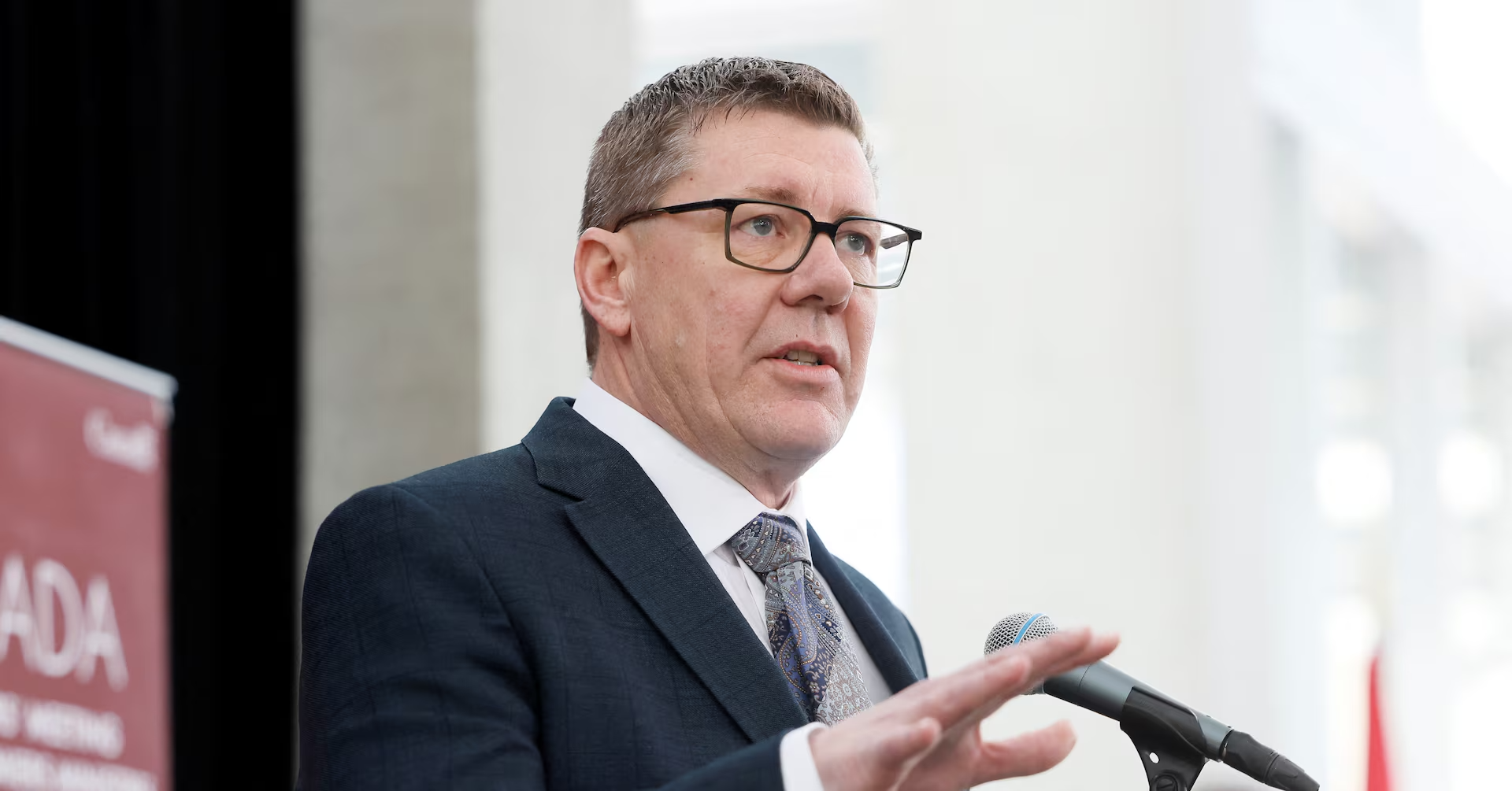
Saskatchewan Premier Scott Moe speaks to journalists before a meeting with provincial and territorial leaders in Ottawa, Ontario, Canada, January 15, 2025. REUTERS/Blair Gable/File Photo
PRINCE ALBERT, SASK. - August 26, 2026
Saskatchewan Premier Scott Moe announced Wednesday that his province will place a 50 per cent levy on American alcohol beginning September 8, a direct response to the wave of new U.S. tariffs on Canadian goods that took effect earlier this month.
Moe made the announcement at the E.A. Rawlinson Centre for the Arts in Prince Albert, flanked by members of his cabinet. He framed the move as a reciprocal measure meant to mirror the tariffs Washington has placed on Canadian exports. "Given the increased tariffs that the United States of America has put on Canadian and Saskatchewan goods, we need to protect ourselves," Moe said.
Rather than pulling American liquor from store shelves entirely, Moe chose to let consumers keep buying it if they wish, with the new charge applied at the point of sale. He said the decision reflects his government's broader approach to the trade dispute. "Our government has decided throughout this that we want to leave the choice with the people of Saskatchewan," Moe said. The levy will be collected by the Saskatchewan Liquor and Gaming Authority rather than remitted to the federal government, a structure that has drawn some questions from critics about whether it amounts to genuine retaliation.
Moe pointed to early results as evidence the approach is already working. Sales of American alcohol have fallen roughly 40 per cent in the province since Canadians began favouring domestic and other alternatives, while Saskatchewan-made products have picked up the difference. "I think that actually sends a much stronger message than any government-ordered ban that could be put in place," Moe said.
The premier drew a firm line, however, around Saskatchewan's two largest export sectors. He ruled out any tariff or export tax on potash or oil bound for the American market, arguing that doing so would put the province's own workers at risk. "Why would you put Canadians out of work with a flawed policy?" Moe said. American tariffs currently touch about 6 per cent of Saskatchewan's economy, while the province's countermeasures are expected to affect close to 11 per cent of its roughly $1.6 billion in annual imports from the United States.
Saskatchewan's approach places it at one end of a widening split among the Prairie provinces over how forcefully to respond to Washington. Alberta Premier Danielle Smith has pushed for de-escalation instead, calling the U.S. tariffs "tragic, unjustified, and wholly unnecessary" while ruling out using her province's oil and gas exports as leverage. Smith has faced added pressure at home from separatist sentiment in Alberta, a factor observers say makes the energy option especially risky for her to play.
President Trump has shown little sign of softening his position. In a recent interview, he said it was "time to teach Canada you can't do this anymore" and claimed the country "doesn't have anything that we have to have." Analysts have pushed back on that framing, noting the United States relies heavily on Canadian energy and minerals, along with electricity imported from provinces like Ontario and Quebec. Trump has also floated raising auto tariffs to 50 per cent starting January 1.
Saskatchewan's alcohol levy takes effect September 8, the same date Ottawa has set for its own national round of retaliatory tariffs on American goods. Moe said he remains focused on restoring certainty to the trade relationship through negotiation rather than further escalation, even as the province moves ahead with its own countermeasure.